
Published 16 May 2026
E-Invoice Limit Rules India
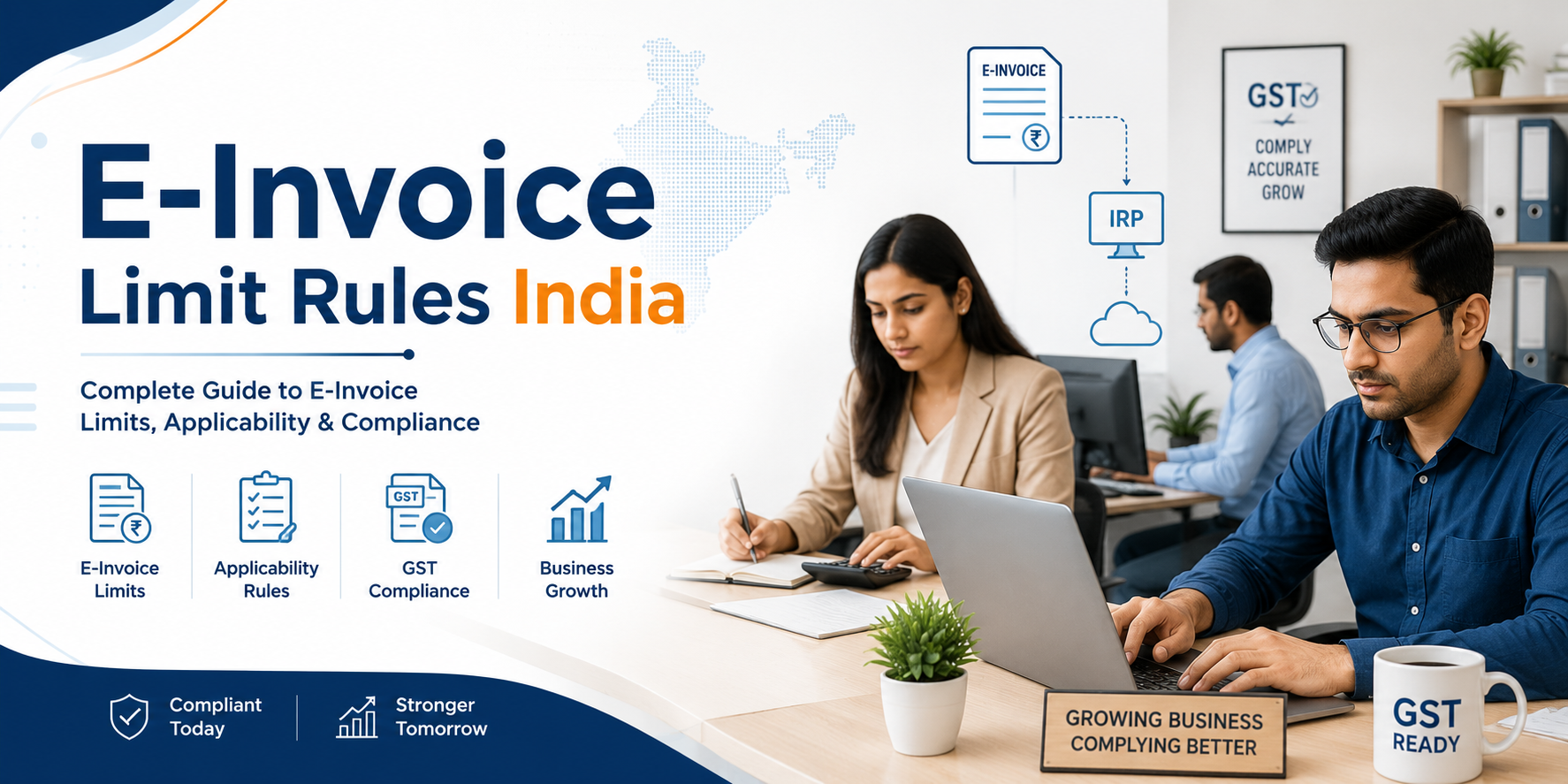
E-invoicing is important to India’s GST system. It helps firms comply with taxes and maintain uniform digital invoicing. E-invoicing, introduced by the Indian government, validates invoices electronically through the Invoice Registration Portal (IRP) before sending them to clients or uploading them for GST filing. More accurate billing, not paying taxes, and mistakes made when filing paperwork by hand are all cut down with this method. Notifying the government of GST e invoice generation requirements is especially important for companies that make more than a certain amount of money each year. These turnover- based e-invoice limits show which businesses are required by GST rules to send electronic bills. Businesses can avoid fines, keep accurate financial records, and make filing taxes easier by following the right e-invoice rules. E-invoicing also helps tax officials by making it easier to track invoices, rendering information more clear, and allowing better oversight of business activities within India's digital taxation system. What Is E-Invoicing in India? Electronic invoicing, a digital invoicing mechanism, was introduced by India's GST to standardise invoice reporting. Eligible organisations must upload invoice details to the Invoice Registration Portal before sending invoices to clients. After checking the invoice information, the IRP gives each one a unique Invoice Reference Number (IRN). Within real time, the Invoice Registration Portal checks the information on invoices sent by businesses as a central authentication tool. After checking, the IRP digitally signs the invoice and creates a QR code with important transaction information like the GSTIN, invoice number, invoice date, and invoice value. Regular invoices are only made in the business system, while government-approved IRPs check the validity of e-invoices before they are used. Businesses that are required to submit GST e-invoices must make sure that the invoice has been validated with an IRN. The IRN is a key part of clearing up tax issues and avoiding duplicate bills. The QR code also makes it easy for tax officers, buyers, and other involved parties in the GST environment to quickly check invoices. Understanding E-Invoice Limit Rules in India India's "e-invoice limit rules" are the turnover levels set by the GST system that tell businesses if they need to make electronic invoices. This is the maximum amount that a business can charge based on its total yearly sales. The Government of India sets these limits through GST rules. For deals that fall under this category, e-invoicing is required once a business hits a certain turnover threshold. Using a single Permanent Account Number (PAN), a company can make taxable supplies, exempt supplies, exports, and interstate supplies worth a total of a business's annual
turnover. Instead of figuring out the income for each GSTIN separately, it is figured out across all GST registrations in India that are linked to the same PAN. As a result, companies that do business in more than one state need to think about how much money they make overall when they check to see if e-invoices are applicable. If a business makes more than the declared turnover threshold in any financial year after the prescribed time, it has to follow the rules for electronic invoices. Companies who qualify must create invoices using the Invoice Registration Portal (IRP) to receive an IRN and mobile QR code before delivering bills to clients. These turnover limitations allow the government to gradually enhance digital tax compliance while giving smaller enterprises time to react. Complying for businesses that are qualified means keeping accurate invoice data, making IRNs in real time, using GST- compliant billing software, and making sure that B2B and export transactions are properly reported under the e-invoicing framework. Current E-Invoice Threshold Limit in India Presently, in India, companies with an annual revenue of more than ₹5 crore are allowed to send electronic invoices. Businesses with more than this amount of sales must use the Invoice Registration Portal (IRP) to create e-invoices for Business-to-Business (B2B), export, and some other activities. As part of its phased implementation strategy to promote digital billing among businesses of all kinds, the government put this limit in place. It is the total annual turnover in any earlier financial year, starting with 2017–18, that determines the turnover threshold. Should a company's sales fall below the limit this year, e-invoicing may still be used if they exceeded the limit in a previous fiscal year. Consistency in GST compliance is ensured by this rule, and the risk of billing reporting gaps is lowered. The e-invoice cap is based on a company's PAN, not on each individual applicant's GST registration. When figuring out India's total turnover, all GSTINs that are tied to the same Permanent Account Number (PAN) are added together. Businesses that operate in more than one state must therefore look at their combined sales numbers to see if e-invoicing is possible. India's government regularly sends out notices and updates about e-invoicing levels through the GST Council and the Central Board of Indirect Taxes and Customs (CBIC). The threshold limit has been slowly lowered over time to allow more businesses to use the digital billing system. This has made taxes more clear and raised awareness of compliance across the country. Evolution of E-Invoice Limits in India Initial Introduction of E-Invoicing
On October 1, 2020, India began adopting GST, which enabled e-invoicing as part of its digital tax agenda. Initially, only enterprises with a yearly revenue over ₹500 crore had to adopt e-invoicing. This gradual rollout helped big businesses get used to the system first, while giving smaller businesses more time to get ready for digital billing to become legal.
Reduction in Threshold Over Time Following the successful completion of the initial phase, the government slowly lowered the bar for annual turnover so that more businesses could use the e-invoicing system. During the reduction steps, • Limit of 500 crore rupees in sales • Maximum earning of ₹100 crore • Limit of 50 crore rupees in sales • Maximum sales of 20 crore rupees • Sales limit of 10 crore rupees • Maximum annual sales of 5 crore rupees Within each step of reduction, GST e invoice generation was made available to more businesses and industries in India. As the rollout happened slowly, companies were able to improve their billing systems, train their accounting teams, and connect their ERP software to the Invoice Registration Portal (IRP). Purpose Behind Gradual Reduction E-invoice limits were gradually lowered to encourage people to pay their taxes online and improve the accuracy of GST invoice reports. Validating invoices online through government systems, e-invoicing helps cut down on fake invoices and tax fraud. Other benefits of the method include better tracking of invoices, more openness in business dealings, and better oversight of input tax credit claims. India's government wants to make taxes easier for businesses of all kinds by gradually lowering the thresholds for turnover. Businesses Required to Generate E-Invoices E-invoicing is required by GST rules for companies whose annual sales are more than the notified government threshold amount. Currently, companies that make more than ₹5 crore must use the Invoice Registration Portal (IRP) to create e-invoices for activities that apply. In most cases, e-invoicing is used for Business-to-Business (B2B) deals, which are when one registered business gives goods or services to another registered business. The e-invoicing
method requires businesses to make invoices with a valid Invoice Reference Number (IRN) and QR code before sending them to customers. e-invoicing rules also cover deals involving exports, since exports are considered taxable goods under GST, even if they are sent out under zero-rated provisions. Additionally, e- invoicing may be needed for deals involving Special Economic Zone (SEZ) units and developers if the business falls into the right turnover group. Electronic invoice standards usually apply to many areas, including manufacturing, wholesale trade, IT, pharmaceuticals, logistics, and big service providers. E-invoicing rules must be followed by any eligible business that made more than a certain amount of money in the previous financial year, no matter what field it works in. How to Calculate Aggregate Annual Turnover for E-Invoice Eligibility According to GST, one of the most important ways to tell if a business has to follow e- invoicing rules is to look at its total annual sales. It is the total amount of money that a business in India received from all of its suppliers during a given fiscal year, using a single Permanent Account Number (PAN). Exports, interstate sales, taxable and exempt supplies, and all GST registrations tied to the same PAN are counted in the calculation. GST applies to goods and services that are taxable, while GST does not apply to goods and services that are excluded. Interstate and intrastate trades are both included in aggregate turnover. Supply deals that happen within the same state are called intrastate supplies. Neither is ignored when figuring out the total change needed to be eligible for an e-invoice. The revenue is calculated using PAN instead of GSTIN. Businesses with locations in more than one state must add up the sales from all of their branches and GST registrations that are tied to the same PAN. GST rules say that taxes like CGST, SGST, IGST, and cess are not included in the total turnover figure. Penalties for Non-Compliance with E-Invoice Rules If businesses covered by GST e-invoice regulations don't follow the rules for e-invoicing, it can lead to major legal, financial, and operational issues. A business that is allowed to issue invoices may have to deal with legal problems if they do not get a proper Invoice Reference Number (IRN) from the Invoice Registration Portal (IRP) before sending the invoices. As well as causing compliance problems during audits or departmental checks, an invalid invoice can also lead to GST penalties. If a business doesn't comply with GST documentation standards, reports invoices incorrectly, or doesn't make e-invoices, they may have to pay costs. There may be fines for each wrong invoice sent out.
Buyers can also have problems with input tax credits (ITC) when legal rules aren't followed. As a result, customers may not be able to receive GST credits for transactions that involve invoices that do not have valid IRNs. Some business ties and payment methods may be affected. Creating e-way bills might also get harder because some transactions need proper e-invoice information for transportation paperwork. Furthermore, businesses may experience operational disruptions, late GST filings, more scrutiny from tax authorities, and higher legal risks if they report invoices incorrectly and don't handle compliance well. Benefits of E-Invoicing for Businesses Faster GST Compliance By validating invoices immediately through the Invoice Registration Portal (IRP), e-invoicing makes GST compliance easier. Invoices can be kept correct for GST returns and audits, and businesses don't have to do as much reporting by hand. Reduced Manual Errors Creating invoices by hand often leads to mistakes in GSTIN information, invoice numbers, tax figures, and reporting. Using standard digital formats and automated validation methods, e-invoicing cuts down on these mistakes. As a result, invoices are more accurate and there are fewer delays caused by mistakes. Better Invoice Tracking There is better tracking and monitoring of invoices with e-invoicing because each invoice is registered online with a unique Invoice Reference Number (IRN). With better organization, businesses can easily keep track of their invoices and deals. Easier Tax Filing Customers can easily file their GST returns because invoice data is shared immediately with GST systems. By cutting down on duplicate data entry, GST e invoice generation helps businesses file their GST reports more quickly and correctly. Improved Transparency E-invoicing makes business transactions more clear by providing a standard, verified accounting system for invoices. This creates more trust between buyers, suppliers, and tax officials and lowers the number of fake invoices, tax evasion, and duplicate invoices. Automation Benefits
E-invoicing businesses can connect their accounting or ERP software to GST systems to automatically create invoices and send reports. This decreases paperwork, speeds up business processes in finance and taxes, and makes operations more efficient. Conclusion Because it helps businesses keep their digital invoices correct and makes taxes more clear, e-invoicing has become an important part of India's GST compliance system. Limits on e- invoices based on turnover have helped the government gradually increase compliance across a wider range of business sectors. This has been done while encouraging automation and lowering tax theft. Businesses that have to follow e-invoicing rules need to make sure they generate invoices correctly, validate IRNs, and report promptly to avoid fines and practical problems. Because India's digital taxes system is growing, e-invoicing is likely to play a bigger part in making GST e invoice generation processes easier, making it easier to keep track of invoices, and supporting a more efficient and tech-driven business environment. FAQs 1. What is the current e-invoice limit in India? Businesses that make more than ₹5 crore a year must follow the rules for e-invoicing. 2. Is e-invoicing mandatory for B2C transactions? No, e-invoicing is mostly only used for B2B, export, and a few other specific activities. 3. Can businesses generate e-way bills without e-invoices? Businesses that need to may have trouble making e-way bills without proper e-invoice information. 4. Who is exempt from GST e-invoicing? E-invoicing is not required for banks, insurance companies, GTAs, passenger transport services, and some other groups.