
Published 23 May 2026
Top 10 e-invoice errors & how to fix them
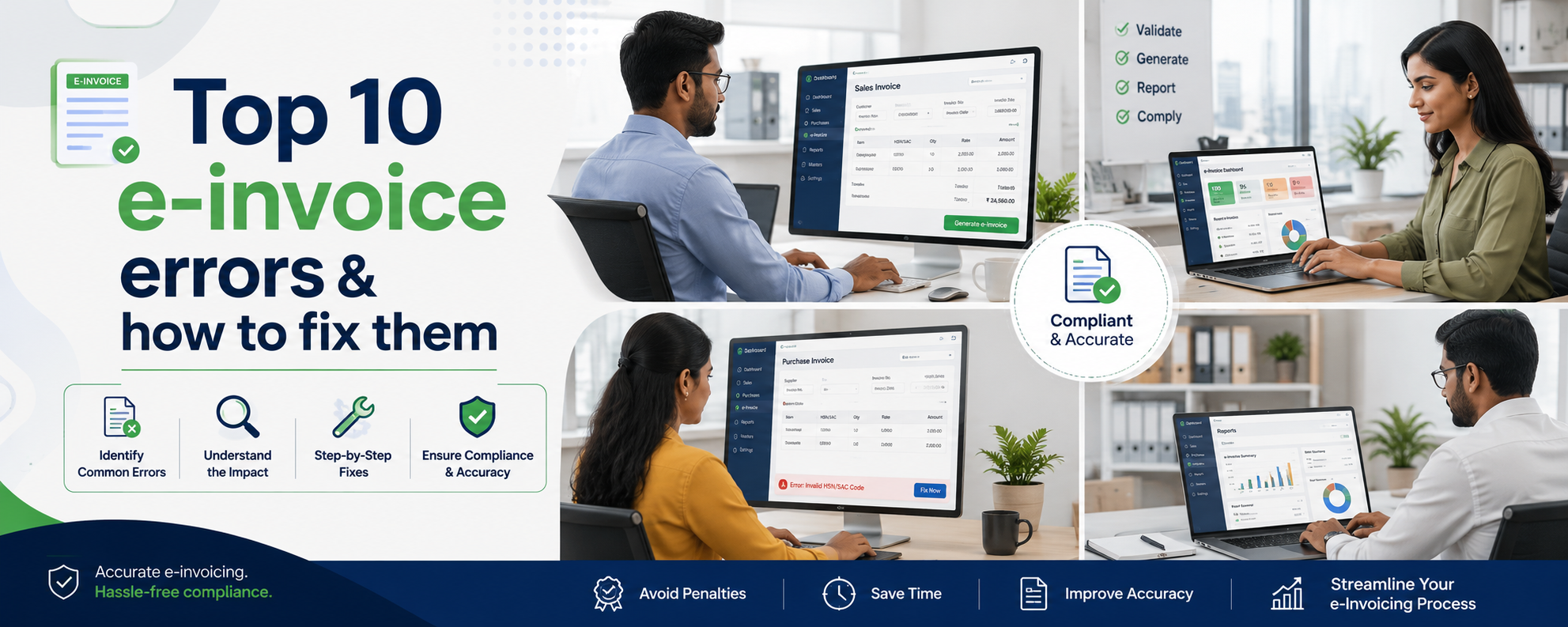
About e invoicing system India, it has revolutionised the financial flow process, making it much quicker, more accurate, and more compliant. For companies to make the most of electronic invoicing, several considerations are needed. This book examines the main problems with how suppliers invoice their customers and offers practical recommendations for switching to online payments. Understanding the most common issues that may arise during e-invoice creation and how to address them will enable the company to manage its billing operations effectively and comply with tax legislation. Now we will analyse the top 10 e-invoice errors and ways to eliminate them. 1. The GSTIN (Tax Identification Number) is wrong Many people make the mistake of entering the wrong GSTIN (Goods and Services Tax Identification Number) when sending an e-invoice. The account Registration Portal (IRP) can reject an account if it contains even one incorrect number. Companies often run into this issue when adding customer data manually or using outdated systems. An incorrect GSTIN not only delays payment approval but can also make it harder to pay taxes and balance the books. They often don't know about the issue until after the bill has been sent. How to Fix It Businesses need to set up automatic GSTIN validation before sending bills. You can see real-time tax information about your customers when you link your payment software to GST records. It's also less likely to make mistakes if you keep the customer master data up to date. This kind of mistake happens much less often when systems are automated and check for validity. 2. Billing numbers that are the same Another big issue with e-invoicing tools is that they might generate multiple invoices with the same invoice number. Most government websites and ERP systems won't accept invoices that use the same number for multiple invoices. This is because each invoice needs a unique number. Most of the time, this mistake occurs when more than one person issues an invoice at the same time or when the invoice order is changed incorrectly. When you have duplicate bills, they can mess up your accounting and make checks more difficult. How to Fix It
To get the best results, it's best to use automated ways to number bills. People who work for businesses should set up their ERP systems to automatically generate sequential, unique invoice numbers. Having a single billing system reduces the administrative burden of managing multiple offices or branches. It is less likely that the same invoice will be reused if invoices are checked regularly. 3. Wrong way to figure out taxes One of the main reasons e-invoices are rejected is tax errors. If the taxes are not set up correctly, the rates are outdated, or the calculations are done by hand, they may not be correct for CGST, SGST, IGST, or VAT. Making mistakes like these can cost you money and delay payments. When a business deals with more than one tax rate, they are more likely to get the maths wrong. How to Fix It When a business bills, it should use tools that can easily figure out taxes. To keep up with new government rules, tax rates need to change frequently. The use of tools that detect errors as they occur will help identify them before sending invoices. Furthermore, companies must periodically check their tax forms to ensure accuracy or not. 4. Wrong HSN or SAC Codes There are many mistakes in GST-compliant billing systems regarding the Harmonised System of Nomenclature (HSN) and the Services Accounting Code (SAC). When things or services are misclassified, it can be hard to follow the rules and make the right tax estimates. Many businesses don't check the latest GST rules before using standard names or old classes. This makes it more likely that the payment won't be accepted when it's checked. How to Fix It A business should keep an up-to-date list of HSN and SAC numbers that follow the latest tax rules. ERP systems should include automated code generation to reduce the number of errors made manually. It is also important to train employees, as those in charge of billing need to know how to sort goods properly. 5. Invoices with wrong formatting There is a need for an invoice to adhere to a particular format for it to be acceptable by the software that implements electronic invoicing. The failure to adhere to such government- prescribed formatting could result in the rejection of an invoice.
When businesses use outdated invoice templates or incompatible software, formatting errors are likely to occur. When ERP systems and government websites don't work together correctly, formatting issues can occur. How to Fix It A business should use standard billing forms that comply with government regulations. By keeping e invoice software India up to date, you can be sure it works with the latest models and forms. Using APIs to connect ERP systems and government websites can also help reduce writing errors. Testing statement styles before using them is another good way to prevent problems. 6. Problems with putting ERP together Many businesses struggle to connect their ERP systems when they need to send e-invoices. Some ancient accounting systems may not support the latest e-invoicing standards. This can make sharing and syncing data difficult. You could lose invoice data, make mistakes when entering it, or have to wait longer to handle your invoices if you don't combine well. Many problems arise when a business uses multiple software applications. How to Fix It Businesses should use cloud-based accounting systems or middleware that integrates well with their current ERP systems. Effective communication and minimal errors occur in the communication process when the systems are programmed with software that provides an API. The other option to ensure success is to hire competent IT experts during the implementation process. 7. Typos When You Type Data by Hand E-invoicing system India still go wrong a lot of the time because of human error. When there are typos in invoice numbers, customer names, times, or product descriptions, it can be hard to follow the rules, and payment may be late. It's even more dangerous for businesses that deal with many bills every day to enter data by hand. One mistake can mess up the entire payment process. How to Fix It The best way to reduce mistakes made by hand is to automate. If a company can, it should use OCR technology, AI, and automated data capture tools to handle bills. Tools that check can find missing or wrong information on a statement before it is sent. Two more ways to ensure data is right are to train employees and ensure processes are always the same.
8. Not Following the Rules for Compliance Many places and companies have different rules for using e invoice software India. It is difficult for businesses operating internationally to comply with all the changes, new requirements, forms, and standards for recordkeeping. Failure to comply may lead to penalties, refusal to process your payment orders, and difficulties with conducting your business. Many businesses don't know about the changes that happen all the time to the rules. How to Fix It Businesses should buy billing software that is ready to comply with the rules and automatically updates itself when the rules change. A company can also stay on the right side of the law by working with tax and compliance experts. The billing method is kept up to date and correct with regular safety checks. 9. Invoice info that wasn't checked properly Firms make many billing mistakes because they don't check their information before submitting it. Invoices lacking vital fields or containing incorrect totals or information may be rejected. If a business lacks proper procedures for validating invoices, errors will only be discovered after payments have been made. This can lead to delays. How to Fix It There should be tools built into the billing process that let people check bills right away. It is easy to use these tools to identify missing or incorrect information. Aside from that, businesses should establish processes for reviewing bills before they are sent. Things are more accurate, and fewer items are rejected when checks are automated. 10. Staff don't get enough training Mistakes will still happen, even with the best e-invoicing tools, if employees don't know how to do it correctly. Many firms create confusing processes without training employees on how to implement them. The staff find it challenging to pay bills, adhere to procedures, and use computer programs, which results in many errors. How to Fix the Problem
For electronic invoicing to succeed, the employees need continuous training. Employee training can be facilitated through workshops, the distribution of system guidebooks, and session facilitation. Teams from business, IT, and operations work better together and close process gaps when they train together.
Why it's more important than ever to get your e-lips right At this point, e-invoice software India isn't just for sending bills; it's an important part of ensuring compliance, keeping funds open, and increasing cash flow. Government websites may not accept an e-invoice if it has even a small mistake. This can slow down payment cycles and make buyers and sellers go back and forth more than necessary. This is very important in places like India, where GST rules are very strict, and billing is now usually done in real time. By using proper e-invoicing, businesses can build customer trust and avoid legal trouble. When there are no mistakes on bills, companies can process funds faster, easily match up accounts, and keep clean financial records. However, repeated mistakes in billing can create negative impacts on the reputation of the company and affect its business processes. Many firms that use inefficient methods like old-fashioned manual ways of billing are more prone to such problems. Also, companies have to send out a lot more bills as they grow. A simple mistake could quickly turn into a major issue if you lack the tools to detect it. Taking this into account, one needs to ensure that the issue of e-invoice correctness becomes a strategic objective rather than just a job to do. Having the right tools for invoicing can significantly reduce risk and improve business efficiency. Tips on How to Avoid Making Mistakes with Your E-Invoice You need to implement a method that prevents mistakes in the first place if you want to stop them. One of the best ways to do things is to automate them. With automated payment systems, you don't have to enter data by hand as much, which is a big reason why mistakes happen. Some of the things that ensure bills are correct before they are sent are real-time validation, automatically filled-in fields, and tax calculation engines. Another important method is to keep master data up to date. Businesses should review customer details, category details, GSTIN details, and tax rate details. Often, bills are declined due to inaccurate information. Updating this information consistently would ensure minimal mistakes. Integration also helps prevent mistakes, which is a big plus. When accounting software, tax portals, and ERP systems are all linked smoothly, data moves without being copied or corrupted. Information is often lost, or mismatches occur when merging isn't done
correctly, which can make the payment process a mess. This hole can be filled by API- based systems that ensure everything stays in sync at all times.
Lastly, companies need to establish a mechanism to verify invoices before issuing them. While a computer may overlook some errors, these mistakes will be easily detected during verification. Combining computerised processes with a manual one results in a procedure that is quick yet accurate. These helpful pointers not only reduce the number of e-invoice software India mistakes but also improve the overall efficiency and profitability of organisations. That being said Electric billing is now an important part of having a business. It's not just a cool thing to have online anymore. However, such errors in creating bills will prove to be an impediment in the smooth functioning of the business, lead to late payments, and may even prove to be a reason for non-compliance, unless they are resolved in time. Companies encounter difficulties in the creation of bills, including wrong entries in GSTIN numbers, duplicate invoicing, incorrect taxation, and ERP system integration. Once you have trained your staff and automated your work process, you will find no trouble in dealing with these situations. Organisations that make use of good e-invoicing systems and follow a stringent policy in terms of compliance will commit fewer mistakes and still maintain top-notch levels of financial reporting. The businesses that will not repeat such mistakes now will be rewarded with the upcoming trends in banking through E-invoicing system India.